Showing posts with label Geman History. Show all posts

Wednesday, November 12, 2008

November 9th

This past Sunday was an important day in German history. As the 19th anniversary of the fall of the Berlin Wall, I expected some jubiliation or some excitement from the Germans. Perhaps they might finally show me some of that taboo pride of Germany. 

I couldn't even find an article in the newspaper. 

But November 9th is the anniversary of another important even in German history-- one who's tragedy trumps the jubliation of "Wiedervereinigung." November 9, 2008 was also the 70th anniversary of Kristallnacht or the start of Hitler's official pogrom against Jews in Germany.

So instead of watching happy German gatherings on TV, I read about Chancellor Angela Merkel's address to the nation where she said, "Racism and Antisemitism must never again have a chance in Germany." Instead of heading into the city to watch a parade, I went into the city to visit the "Victims of National Socialism" Monument.
November 9th is a perfect example of the tension between past and present in Germany, a tension between legacy and future. Germans chose to respect the victims of their past and switch their national holiday to October 3rd. I think the Germans made the right choice.

Tuesday, October 14, 2008

Salt and the Sound of Music

Salt built Munich, plain and simple. Without the rich salt trade of the middle-ages, Henry the Lion would never have been able to reroute the salt through the city, bringing it enourmous wealth and influence.

Although salt (Salz in German) came from the center of the salt universe, Salzburg (see the word "Salz" in there?), Munich overshadows Salzburg economically and culturally today. Still, the small town, just two hours away is an inviting trip for any "Münchener." I travelled over the Austrian border this past weekend to check it out.

The city is, of course, very musical. Mozart and Haydn both come from the city, and the von Trapp family escaped the Nazis from their home in Salzburg as documented in the film, "The Sound of Music." Seeing the piano where Mozart composed his Sonata in C, a song I often played when I took lessons, made me miss my music.

Salzburg is also very beautiful. Nestled among Alpine foothills, the "Festung Hohensalzburg" (Fortress of Salzburg) gives great views of the city and the region. Church steeples and fall colors added to the grandeur of the experience.
Luckily, a friend of mine has been to Salzburg many times and could show us around. We also met up with the family his mother stayed with when she was an exchange student in Salzburg. Despite not knowing three of the four American students who entered their home, they treated us to an evening I won't forget.

The family immediately served us fresh, homemade, Austrian apple streudel (the apples came from the garden, I might add). When we admitted to not knowing what Kaiserschmarrn was, they insisted on making the Austrian dish immediately for us to try. We discussed politics, family, culture, and, once they found out I am from Detroit, cars. Their hospitality left quite the impression on all of us!

Thursday, October 9, 2008

Living History, Part Three

Last year in my German class, I struggled to understand a text we were reading. It spoke of RAF and terror in the 1970s. I knew that the Royal Air Force was terrifying to Germans during WWII, but in the 1970s?

RAF actually stands for "Rote Armee Faktion," or "Red Army Faction." This terrorist organization in West Germany was born out of German frustration following the second world war. After 1945, Germany vowed to never again bring war upon the planet. The people wanted to rebuild themselves as a just, equitable soceity. Instead, some began to see West Germany as a sort of police state, keeping the masses quiet while allowing the rich to profit off the world's evils.

When political moves and lengthy columns failed to achieve the desired result, Andreas Baader and Ulrike Meinhof (journalist and mother of two) lead a coalitions of young, radically-left Germans into battle. By bombing capatalist buildings and army outposts, the Baader-Meinhof complex spawned a movement that killed 34 people and may have helped hijack a Lufthansa plane.

Germany, always examining its past, touched upon the "German Autumn" of terror in a recent film entitled the Baader-Meinhof Komplex. I went to see the much-debated release a few weeks back. With many young Germans upset about globalization, some feared that "Baader-Meinhof Komplex" would inspire the most troubled to action. 

The movie, however, does not portray RAF as a young group of idealistic heros. Instead, it allows the viewer to watch their descent into violence-- with each attack becoming a reason for more. They weren't protesting capitalist excess; they were justifying their own violence.

Sunday, October 5, 2008

Living History, Part Two

Although most Americans can list the horrors that occured during the Nazi era in Germany, few can name the small group that stood for political and religious freedom during that same era. "Die Geschiwster Scholl," or "The Scholl Siblings," stood up to Nazis and lost their lives because of it.

Sophie and Hans Scholl started a group called the White Rose. Composed of a small group of core members, they printed anti-facist flyers and mailed them to thousands of people in various German cities, all at their own expense. When it came time to distribute the sixth flyer, Sophie and Hans decided to lay them around their university building in Munich during classes. 

While attempting to directly contact their politically active peers, Sophie pushed a stack of papers over the railing, sending flyers fluttering into the main hall of the university.
The action, which caught the attention of the university manager and lead to the end of the White Rose, is now a symbol of student resistance in Germany. And it took place in the main hall of the university I now attend.

Last week we watched Sophie Scholl: the last days, a moving film about her protest and sentencing at the hands of the Nazis. Wether it was the main hall of the university or the places the prisoners were shuttled to and from, these places permeate my own life in Munich.

Wether I'm passing through "Geschwister Scholl Platz" or passing by the cemetary where Sophie was buried, Munich and the University pay fitting tribute to these inspiring heros.

Saturday, October 4, 2008

Living History, Part One


One reason I've always enjoyed taking German classes has to do with Germany's relationship to its past. Germany has some pretty hefty subjects to grapple with. Martin Luther's rebellion, two world wars, and the holocaust don't easily pass from a people's collective memory. 

Germany doesn't try to forget either. While I haven't even been here a month yet, I encounter German history often. Golden cobblestones mark houses where Jews forced from their homes during World War II lived. Bullet holes can still be seen from where Hitler fought Bavarian police during his 1923 putsch. The Dachau Concentration Camp lies right outside the city.

On Thursday, I used my day off from school to go to Dachau, something I was not looking forward to, but knew I had to do. Dachau was a work camp, not an extermination camp, so the exhibits focused mostly on the terrible labor and conditions that prisoners (political enemies of the Nazis, Jews, homosexuals, etc.) went through. While Dachau didn't have gas chambers or ovens, the SS murdered thousands of "attempted escapees," allowed thousands more to die of starvation and exhaustion, and performed brutal, "medical" experiments on prisoners.
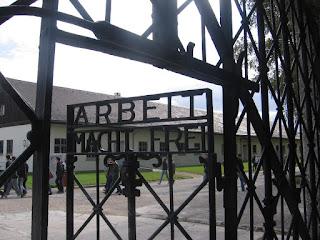
Walking up to the camp from the bus stop, I was looking at the beautiful fall colors when I suddenly caught a glimpse of the iconic "ARBEIT MACHT FREI" ("work will set you free") gate leading into the camp. I felt like someone had punched me in the stomach. Seeing this image in person suddenly made the horrors of the holocaust tangible. It lept from the pages of a history book into cold, hard reality. I felt like puking.

The camp memorial, financed by the German government, doesn't seem to skip over anything. Graphic photos of prisoners line the museum. Details of Nazi brutality sit on every display case. Clips from WWII-era German newspapers show the propoganda and lies surrounding the camp.

The camp continues to negatively affect people, as well. The City of Dachau lies about a half hour outide of Munich. Although Munich and the surrounding area are the most expensive places to live in all of Germany, Dachau remains very cheap. People don't want to live near the camp.

German liscense plates also show where the car is registered. People from Munich have a M as the first letter. People from Dachau have DAH. Cars with DAH inside Munich are often keyed.

While current Dachau residents are just as guilty of the atrocities commited at the camp as I am, the anger towards their city isn't hard to understand. Everyone knows the name Dachau for a reason. And it's a reason today's Germans wish had never happened.

[correction appended 19. January, 2009: Dachau did, in fact, have a gas chamber and ovens. Whether the gas chamber was ever used for mass exterminations is apparently debatable, but the ovens were often used to cremate the remains of murdered "attempted escapees" and starved prisoners.]