Sunday, October 5, 2008

Living History, Part Two

Although most Americans can list the horrors that occured during the Nazi era in Germany, few can name the small group that stood for political and religious freedom during that same era. "Die Geschiwster Scholl," or "The Scholl Siblings," stood up to Nazis and lost their lives because of it.

Sophie and Hans Scholl started a group called the White Rose. Composed of a small group of core members, they printed anti-facist flyers and mailed them to thousands of people in various German cities, all at their own expense. When it came time to distribute the sixth flyer, Sophie and Hans decided to lay them around their university building in Munich during classes. 

While attempting to directly contact their politically active peers, Sophie pushed a stack of papers over the railing, sending flyers fluttering into the main hall of the university.
The action, which caught the attention of the university manager and lead to the end of the White Rose, is now a symbol of student resistance in Germany. And it took place in the main hall of the university I now attend.

Last week we watched Sophie Scholl: the last days, a moving film about her protest and sentencing at the hands of the Nazis. Wether it was the main hall of the university or the places the prisoners were shuttled to and from, these places permeate my own life in Munich.

Wether I'm passing through "Geschwister Scholl Platz" or passing by the cemetary where Sophie was buried, Munich and the University pay fitting tribute to these inspiring heros.

Saturday, October 4, 2008

Living History, Part One


One reason I've always enjoyed taking German classes has to do with Germany's relationship to its past. Germany has some pretty hefty subjects to grapple with. Martin Luther's rebellion, two world wars, and the holocaust don't easily pass from a people's collective memory. 

Germany doesn't try to forget either. While I haven't even been here a month yet, I encounter German history often. Golden cobblestones mark houses where Jews forced from their homes during World War II lived. Bullet holes can still be seen from where Hitler fought Bavarian police during his 1923 putsch. The Dachau Concentration Camp lies right outside the city.

On Thursday, I used my day off from school to go to Dachau, something I was not looking forward to, but knew I had to do. Dachau was a work camp, not an extermination camp, so the exhibits focused mostly on the terrible labor and conditions that prisoners (political enemies of the Nazis, Jews, homosexuals, etc.) went through. While Dachau didn't have gas chambers or ovens, the SS murdered thousands of "attempted escapees," allowed thousands more to die of starvation and exhaustion, and performed brutal, "medical" experiments on prisoners.
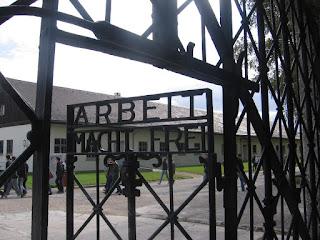
Walking up to the camp from the bus stop, I was looking at the beautiful fall colors when I suddenly caught a glimpse of the iconic "ARBEIT MACHT FREI" ("work will set you free") gate leading into the camp. I felt like someone had punched me in the stomach. Seeing this image in person suddenly made the horrors of the holocaust tangible. It lept from the pages of a history book into cold, hard reality. I felt like puking.

The camp memorial, financed by the German government, doesn't seem to skip over anything. Graphic photos of prisoners line the museum. Details of Nazi brutality sit on every display case. Clips from WWII-era German newspapers show the propoganda and lies surrounding the camp.

The camp continues to negatively affect people, as well. The City of Dachau lies about a half hour outide of Munich. Although Munich and the surrounding area are the most expensive places to live in all of Germany, Dachau remains very cheap. People don't want to live near the camp.

German liscense plates also show where the car is registered. People from Munich have a M as the first letter. People from Dachau have DAH. Cars with DAH inside Munich are often keyed.

While current Dachau residents are just as guilty of the atrocities commited at the camp as I am, the anger towards their city isn't hard to understand. Everyone knows the name Dachau for a reason. And it's a reason today's Germans wish had never happened.

[correction appended 19. January, 2009: Dachau did, in fact, have a gas chamber and ovens. Whether the gas chamber was ever used for mass exterminations is apparently debatable, but the ovens were often used to cremate the remains of murdered "attempted escapees" and starved prisoners.]


Friday, October 3, 2008

Happy "Day of German Unity"

Prayer of Thanks

Europe is making a good impression on me. The people are friendly, good-hearted, and seem to be honestly concerned about important issues like global warming, poverty, and peace-- which is more than I can say for many people in the USA. 

But something I can't grasp is Europe's relationship with religion. The continent is becoming more and more secular, despite recent the EU addition of Catholic powerhouse Poland. But European governments continue to meddle in religious affairs. Although Germany promotes religious freedom, it doesn't have a separation of church and state. 

Upon moving to Germany, I had one week to register with the police as every new arrival must. My application forms always asked what religion I was. I decided to leave that question blank every time, and the Munich clerk didn't give me any problems. But others in the group who also decided not to register their religion were questioned about why.

German schools teach religion, too. Each student receives instruction in their (or their parents') religion, and Germany offers the option to take an "ethics" class for non-religious people. But at every university, the Catholic or Evangelical Church (or, lately, the Islamic governing body) has complete power to remove faculty in their respective theology departments who don't toe the Church's line. This doesn't sound like academic freedom to me.

Religion (or fear thereof) is radically reshaping the continent's political landscape, too. On the far right, a small group of politicians loudly complain about Muslim immigrants. A few political posters I've seen here even advocate for a complete ban on the building of Mosques. These people are certainly in the minority though, as evidenced by the huge, disruptive counterdemonstrastions against them in Cologne last week.

But even the question of allowing headscarfs in schools gets honest play from politicians across the political spectrum. At Oktoberfest today, I met an Austrian couple who were not happy about their country's recent turn towards more conservative government. However, they did advocate a complete ban on headscarfs in Austrian schools.

I proudly told them that this isn't even an issue in the USA. Our system isn't perfect, but we have found a healthy relationship between Church and State. We don't tell people how to practice their religion or what they can and cannot express in public. We don't register people's private religious beliefs in government databases. History plays a big role, but Europe would do well to look west for its governments' religious future.

Wednesday, October 1, 2008

On My Own Again...

For the first time ever, I'm living on my own. Yes, my parents are paying tuition, housing, and health insurance, but aside from that, I'm independent. No roommates to clean up after me. No meal plan to feed me. No mother to do my laundry. It's all me this time.

So far, I'm pretty happy. My apartment is fairly clean, and my diet is healthy. I'm enjoying Munich, and I think I'll be able to budget enough to make it through the year.

However, this has enhanced my appreciation for my mother. As I go home from class, I'm running through mental lists of what I can make for dinner, what I have in my tiny fridge, and what I need to pick up. I expend a lot of mental energy doing this, and I'm only cooking for myself, much less a family of four vegetarians. Plus, my mom goes to "the farm" at least once a week, and she does a great job of preparing local, organic food. While worth the effort, going to the local Wal-Mart would be much easier (and cheaper).

Now that I'm accostumed to the German grocery shopping system, I've yet to find an easy way to do it-- much less to the same quality my mom does. When she comes over for Christmas, maybe she can teach me a few lessons. Oh, and give me new recipes, because I'm getting sick of pasta! 

Sunday, September 28, 2008

Of Lederhosen and Leiche

I took another trip into the Alps with some friends today. Not only did we hike to the top of the Rotwandgipfel, but we did it in lederhosen. Now you get to see me in lederhosen for the first official time!

From The Alps
More pictures on my Picasa page.

I also walked through a beautiful graveyard in Munich the other day. The grave stones were all from the 1700s and 1800s.

Eins, Zwei, G'Suffa!

One thing separates Oktoberfest from the Fulton County Fair: world class beer. And, man, does that make a difference. Without those six world-renowned breweries setting up tents, the Theresienwiesen would be just a second-class carnival and 4H fair with 5.9 million fewer people for these precious two weeks.

But Spaten, Löwenbräu, Hofbräu, Paulaner, Hacker-Pschorr, and Augustiner (order does not indicate preference here!) do set up 12 different beer tents and serve six million liters of beer to millions of thirsty patrons. These six Munich breweries already make pretty strong (and tasty!) brews, but the alcohol content shoots up to around 6% for their Oktoberfest brews. And you can only order the beers a liter at a time. That's why you've heard of Oktoberfest before.

Does it get crazy? Yes. Does it get out of hand? It depends who answers this question. I've observed that most Bavarians like to get to the "Wies'n," drink slowly, eat a "brezel" or two, and chat over a chicken dinner. Thus, they stay in control. Italians like to drink slowly, too, but then the males starting hitting on every girl in sight. The Brits like to drink quickly. The Australians and Americans drink slower than the Brits, but make up for that in singing volume and table dancing extravaganzas.

Speaking of singing and dancing, each tent has its own Bavrian oompah band. But they can play more than "Roll Out the Barrel." "Country Roads" is a favorite, along with "Living on a Prayer" and a few German drinking songs. But the one every Oktoberfester must know is "Ein Prosit"-- a toast. Every 15 minutes, the band breaks this bad boy out, and every 15 minutes, the tent erupts into a frenzy of clinking beer steins. Glorious!